Stop running your own job processing pipeline.
ClassifyCore ingests, cleans, classifies and enriches jobs at any scale — from 1,000 to 10 million postings. Delivered to your job board via XML or API.
A full-service pipeline that ingests, cleans, classifies and enriches job data at scale. Built for job boards, aggregators, ATS platforms and programmatic vendors who need clean, structured jobs delivered to their site — without building or maintaining the infrastructure themselves.
The Problem
Running a job board or aggregator means moving job data from dozens or hundreds of sources into a single, clean, classified, searchable inventory. The operational cost is rarely budgeted properly:
- Feeds arrive in inconsistent XML schemas, broken RSS, partial APIs, and bespoke integrations. Each source breaks differently and at a different cadence.
- Duplicates compound across sources. The same role posted by an employer, two agencies and an aggregator becomes four listings, four indexed pages, and four hits on Google's helpful content radar.
- Classification done on the job title alone misses the actual content of the role. Seniority, employment type, remote arrangement, salary, licences, education requirements — all sit inside the description and most platforms never extract them.
- The engineering team that should be building product ends up maintaining scrapers, dedup rules, taxonomy mappings and feed monitoring.
The result is a thinner inventory than the raw feed count suggests, weaker Google Jobs schema, fewer filters on category pages, lower-quality email alerts, and an engineering team distracted from the things that actually grow revenue.
How It Works
ClassifyCore is a four-stage pipeline. You point your sources at it and tell it where to deliver. The infrastructure, models and operational monitoring sit on our side.
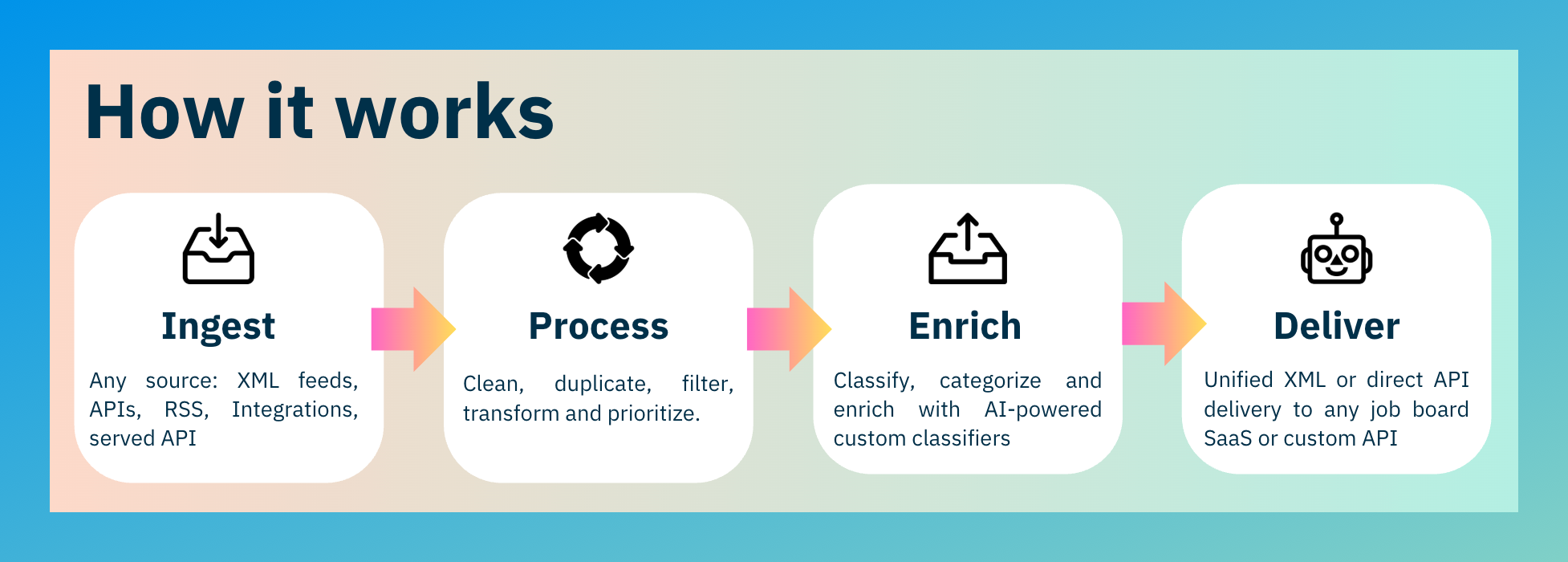
1. Ingest — Any source: XML feeds, JSON APIs, RSS, ATS integrations, partner feeds, served APIs. New sources are onboarded without engineering effort on your side.
2. Process — Normalize, deduplicate, filter and prioritize. Duplicate logic operates across sources, not just within them, so the same role from an employer + two agencies + an aggregator collapses to one canonical posting.
3. Enrich — Classify against any official taxonomy (ESCO, O*NET, SOC, UKSSC, NOC, KLDB) or a custom client-specific taxonomy. Extract structured attributes from the full job description, not just the title.
4. Deliver — Unified XML feed, direct API push, or native integration with major job board SaaS platforms.
What ClassifyCore Actually Does
1. Any enrichment, from the full job description
Most classification tools read the title and stop. ClassifyCore reads the full description and extracts structured attributes that should live in your schema, your filters and your email alerts but usually don't:
- Taxonomy mapping — ESCO, O*NET, SOC, UKSSC, NOC, KLDB, plus custom client-specific taxonomies for niche markets
- Employment type — full-time, part-time, contract, temporary, internship, apprenticeship
- Seniority — entry, junior, mid, senior, lead, executive
- Salary and salary band — extracted from any format and normalized to your currency and period
- Remote type — on-site, hybrid, fully remote
- Extended remote — specific in-office vs. home-office day patterns where stated
- Shift information — day, night, rotating, weekend
- Licences and certifications — extracted and normalized
- Education and degree requirements
- Address enrichment — geocoding, region/county/metro mapping
- Benefits — extracted and categorized
- Contact Details — extracted and remove contact detals, phone numbers, emails
If it's in the job description, we extract it and normalize it. The downstream effect: complete Google JobPosting schema, category pages that target long-tail intent ("registered nurse night shift Manchester"), more filters on search pages, and email alerts that actually match what the candidate asked for.
2. No infrastructure required
Scrapers, feed monitoring, deduplication rules, classifier retraining, taxonomy maintenance, multilingual coverage — none of it lives on your side. You tell us where to deliver. We handle everything before that point.
Scales from 1,000 jobs to 10 million. Same pipeline, same SLAs. Your engineering team works on product, not on the gap between a vendor's XML feed and your search index.
3. Cleaner inventory than your raw feed
Extensive cross-source deduplication collapses expanded and duplicated jobs that inflate inventory counts without adding value. Custom filtering can be applied at any field — title patterns, locations, sectors, employment types, sources — so you only receive jobs that fit your niche. Multilingual: any language in, normalized output.
Use Cases
- Job aggregators — Onboard hundreds of sources, deduplicate across them, classify into a unified taxonomy, deliver one clean feed to your search index.
- Niche job boards — Filter a broad source down to your sector, enrich with the attributes your candidates actually filter on, and build category pages around real long-tail intent.
- HCM and ATS platforms — Standardize job data flowing through your platform with consistent taxonomy mapping and enrichment.
- Recruiting agencies — Process and classify incoming requisitions at scale, route by skill and location, surface gaps.
- Programmatic job ad vendors — Clean, classify and enrich publisher inventory before bid logic runs.
Where It's Deployed
ClassifyCore's pipeline and underlying technology are in production across:
- crypto-careers.com and web3jobs.io — niche aggregators in Web3 / crypto
- jobsgopublic.com and lgjobs.com — UK public sector
- nurses.co.uk, healthjobs.co.uk and healthcarejobs.ie — healthcare
- prosple.com — early careers, multi-region
- Multiple Jobiqo client deployments across Europe
Pricing and Engagement
ClassifyCore is priced per deployment based on volume, number of sources, taxonomy complexity and delivery format. Engagements typically include:
- Scoping call to map sources, target taxonomy and delivery format
- Onboarding of initial sources and taxonomy configuration
- Custom classifier training where the use case warrants it
- Ongoing pipeline operation, monitoring and source maintenance
Request a quote below with a short description of what you're trying to solve and we'll come back with scope and pricing.
Related Services
- Job Taxonomies — taxonomy design before pipeline implementation
- AI Automation & Job Classification — the consulting layer behind ClassifyCore's classifiers
- Job Board SEO & Google Jobs — what clean, enriched job data unlocks downstream
Frequently Asked Questions
How often can the data be updated?
Can you handle non-English job feeds?
How long does onboarding take, and what's the work on our side?
Can you extract custom information from jobs that isn't on your standard list?
How accurate is the classification, and can we audit it?
Can you source organic jobs from employer career pages for us?
Does this work with our existing job board software, and what happens if we want to leave?
Request a Quote
Tell us what you're trying to solve. Alexander will reply within 1–2 working days with scope and a quote.
Clean, classified job data, delivered.
Tell us what you're trying to solve. We'll come back with scope and a quote.